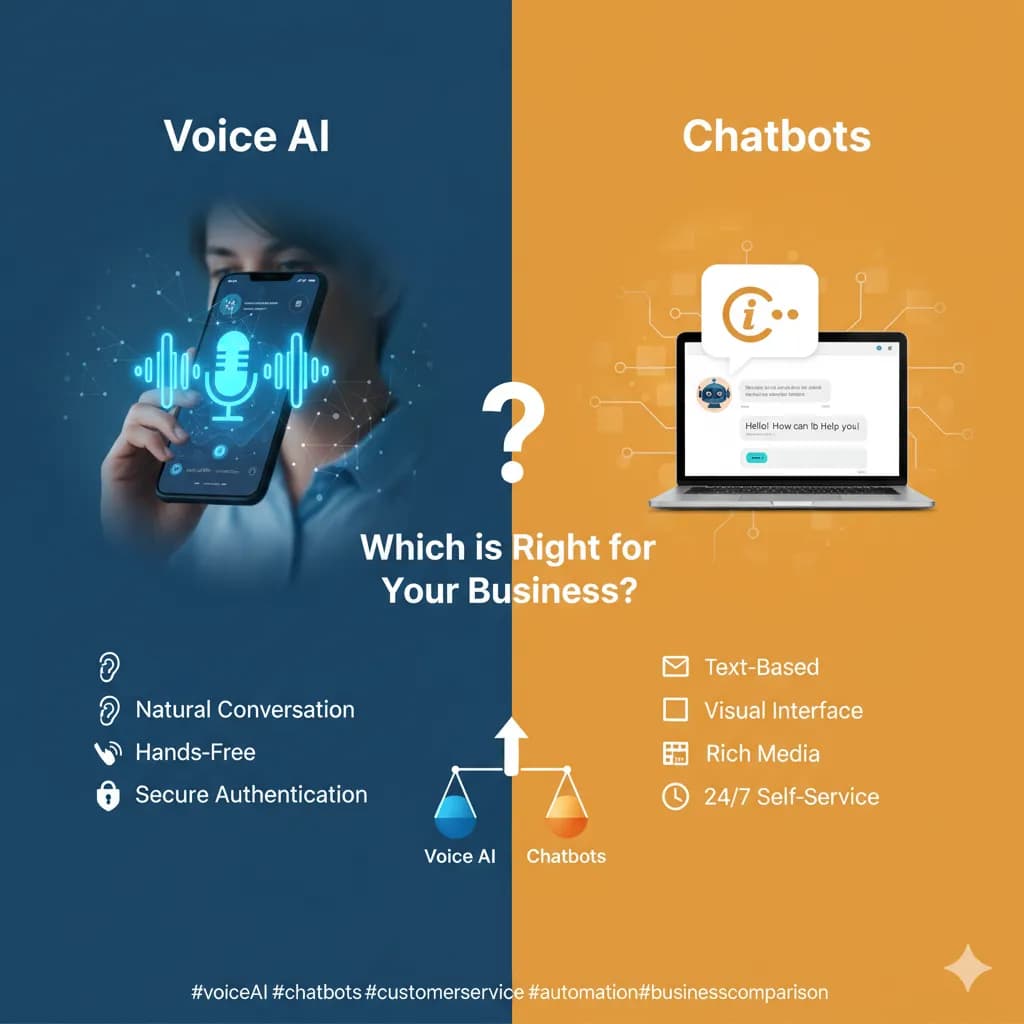
Voice AI vs Chatbots: Which is Right for Your Business?
In today's competitive business landscape, automation technologies are no longer optional—they're essential for delivering exceptional customer experiences while managing costs effectively. Two of the most popular customer service automation solutions are voice AI and chatbots, but choosing between them can be challenging.
This comprehensive guide will help you understand the key differences between voice AI and chatbots, their respective strengths and limitations, and most importantly, which solution is right for your specific business needs.
Understanding the Fundamentals
What are Chatbots?
Chatbots are text-based conversational AI systems that interact with customers through written messages. They can be deployed on websites, messaging platforms, mobile apps, and social media channels. Modern chatbots range from simple rule-based systems to sophisticated AI-powered platforms that can handle complex conversations.
What is Voice AI?
Voice AI systems use speech recognition, natural language processing, and speech synthesis to enable spoken conversations with customers. These systems can handle phone calls, voice commands, and integrate with smart speakers and mobile devices.
Detailed Comparison
1. User Experience and Accessibility
Chatbots:
- Advantages: Visual interface allows for buttons, quick replies, and rich media
- Convenience: Users can multitask while chatting
- Record Keeping: Automatic transcript of the entire conversation
- Accessibility: May be challenging for users with visual impairments or reading difficulties
Voice AI:
- Advantages: Natural, conversational interface that feels more human
- Accessibility: Excellent for users with visual impairments or those who prefer speaking
- Hands-Free: Ideal for situations where users can't type (driving, cooking, etc.)
- Speed: Often faster than typing for complex queries
2. Implementation and Technical Requirements
Chatbots:
- Integration: Easier to integrate with existing websites and messaging platforms
- Development Time: Generally faster to develop and deploy
- Infrastructure: Lower technical requirements and server costs
- Maintenance: Easier to update and modify conversation flows
Voice AI:
- Integration: Requires telephony integration for call handling
- Development Time: More complex development due to speech recognition requirements
- Infrastructure: Higher processing power needed for real-time speech processing
- Maintenance: More complex due to accent variations and speech patterns
3. Cost Considerations
Chatbots:
- Initial Investment: Lower upfront costs
- Operational Costs: Minimal ongoing costs for text processing
- Scaling: Cost-effective to handle high volumes
- ROI Timeline: Faster return on investment
Voice AI:
- Initial Investment: Higher due to telephony and speech processing infrastructure
- Operational Costs: Higher per-interaction costs due to processing requirements
- Scaling: More expensive to scale but handles complex interactions better
- ROI Timeline: Longer payback period but potentially higher long-term value
4. Functional Capabilities
Chatbots:
- Data Collection: Excellent for gathering structured data through forms
- Rich Media: Can display images, videos, and interactive elements
- Integration: Easy integration with CRM and business systems
- Languages: Generally easier to support multiple languages
Voice AI:
- Natural Conversation: Handles interruptions and natural speech patterns
- Emotional Intelligence: Can detect tone and emotional cues
- Complex Queries: Better at understanding context and nuanced requests
- Authentication: Voice biometrics for secure identity verification
Industry-Specific Use Cases
E-commerce and Retail
Chatbots Excel At:
- Product searches and recommendations
- Order tracking and status updates
- FAQ handling and store information
- Cart abandonment recovery
Voice AI Excels At:
- Customer support for complex issues
- Order placement through voice commands
- Accessibility for elderly or disabled customers
- Hands-free shopping experiences
Healthcare
Chatbots Excel At:
- Appointment scheduling
- Symptom checking and triage
- Medication reminders
- Insurance verification
Voice AI Excels At:
- Emergency response and urgent care
- Patient consultation and follow-ups
- Hands-free medical record updates
- Accessibility for patients with limited mobility
Financial Services
Chatbots Excel At:
- Account balance inquiries
- Transaction history
- FAQ and product information
- Fraud alert notifications
Voice AI Excels At:
- Secure authentication and verification
- Complex financial advice and consultations
- Emergency fraud reporting
- Accessibility for visually impaired customers
B2B Services
Chatbots Excel At:
- Lead qualification and capture
- Technical support documentation
- Service request tracking
- Integration with business tools
Voice AI Excels At:
- Sales consultations and demos
- Complex technical support
- Executive-level customer service
- Relationship building and trust
When to Choose Chatbots
Choose chatbots when:
- Budget is a Primary Concern: Limited resources and need quick ROI
- Simple, Structured Interactions: FAQ, basic support, information delivery
- Visual Elements are Important: Product catalogs, images, videos
- 24/7 Self-Service: Customers prefer to find answers independently
- High Volume, Low Complexity: Many similar queries that can be templated
- Quick Implementation Needed: Need to deploy within weeks rather than months
When to Choose Voice AI
Choose voice AI when:
- Complex Customer Needs: Multi-step processes, consultative selling
- Human-Like Experience is Crucial: Building relationships and trust
- Accessibility is Important: Serving customers with diverse abilities
- Phone-Based Business Model: Existing call center infrastructure
- Premium Customer Service: Differentiating through superior experience
- Hands-Free Requirements: Customers often multitask during interactions
Hybrid Approaches: The Best of Both Worlds
Many successful businesses don't choose between voice AI and chatbots—they use both strategically:
Sequential Deployment
Start with chatbots for common queries and implement voice AI for complex issues that require escalation.
Channel-Specific Implementation
Use chatbots on websites and apps, voice AI for phone support.
Customer Preference-Based Routing
Allow customers to choose their preferred interaction method.
Integration Strategy
Create seamless handoffs between chatbots and voice AI systems.
Making the Right Choice for Your Business
Assessment Framework
1. Analyze Your Customer Base
- Demographics and tech comfort level
- Preferred communication channels
- Types of inquiries received
2. Evaluate Your Business Model
- Complexity of products/services
- Sales process requirements
- Customer lifetime value
3. Consider Operational Factors
- Existing infrastructure
- Team capabilities
- Budget constraints
- Timeline requirements
4. Define Success Metrics
- Customer satisfaction targets
- Cost reduction goals
- Response time requirements
- Conversion rate objectives
Implementation Best Practices
For Chatbots
- Start Simple: Begin with FAQ and common queries
- Design Conversational Flows: Map out user journeys carefully
- Provide Escape Routes: Always offer human escalation
- Monitor and Optimize: Continuously improve based on user feedback
For Voice AI
- Focus on Use Cases: Identify specific problems to solve
- Train for Accents: Ensure system works for your customer base
- Plan for Integration: Connect with existing business systems
- Test Extensively: Voice interactions are more complex to get right
Future Considerations
The line between chatbots and voice AI is blurring as technology advances:
- Multimodal Interfaces: Systems that combine text, voice, and visual elements
- Advanced AI: More sophisticated understanding and reasoning capabilities
- Unified Platforms: Single systems that can handle both text and voice interactions
- Emotional AI: Better detection and response to customer emotions
Conclusion
The choice between voice AI and chatbots isn't always binary. The best solution depends on your specific business needs, customer preferences, and operational requirements. Many successful companies use both technologies strategically, deploying them where they provide the most value.
Consider starting with the solution that addresses your most pressing business challenge and highest-value use cases. As you gain experience and see results, you can expand and potentially implement both technologies in a complementary fashion.
Remember, the goal isn't to choose the most advanced technology—it's to choose the right technology that delivers the best outcomes for your customers and your business.
Need help deciding which solution is right for your business? Our team can help you assess your specific needs and develop a customized automation strategy.today.