ROI of Voice AI: A Business Leader's Guide to Measuring Success
Voice AI implementations are no longer experimental technologies—they're strategic business investments that can deliver substantial returns when properly planned and executed. However, calculating the true ROI of voice AI requires understanding both the direct financial impacts and the broader business benefits that may not immediately appear on the balance sheet.
This comprehensive guide provides business leaders with frameworks, metrics, and real-world examples to accurately assess, measure, and maximize the return on investment for voice AI initiatives.
Understanding Voice AI ROI Components
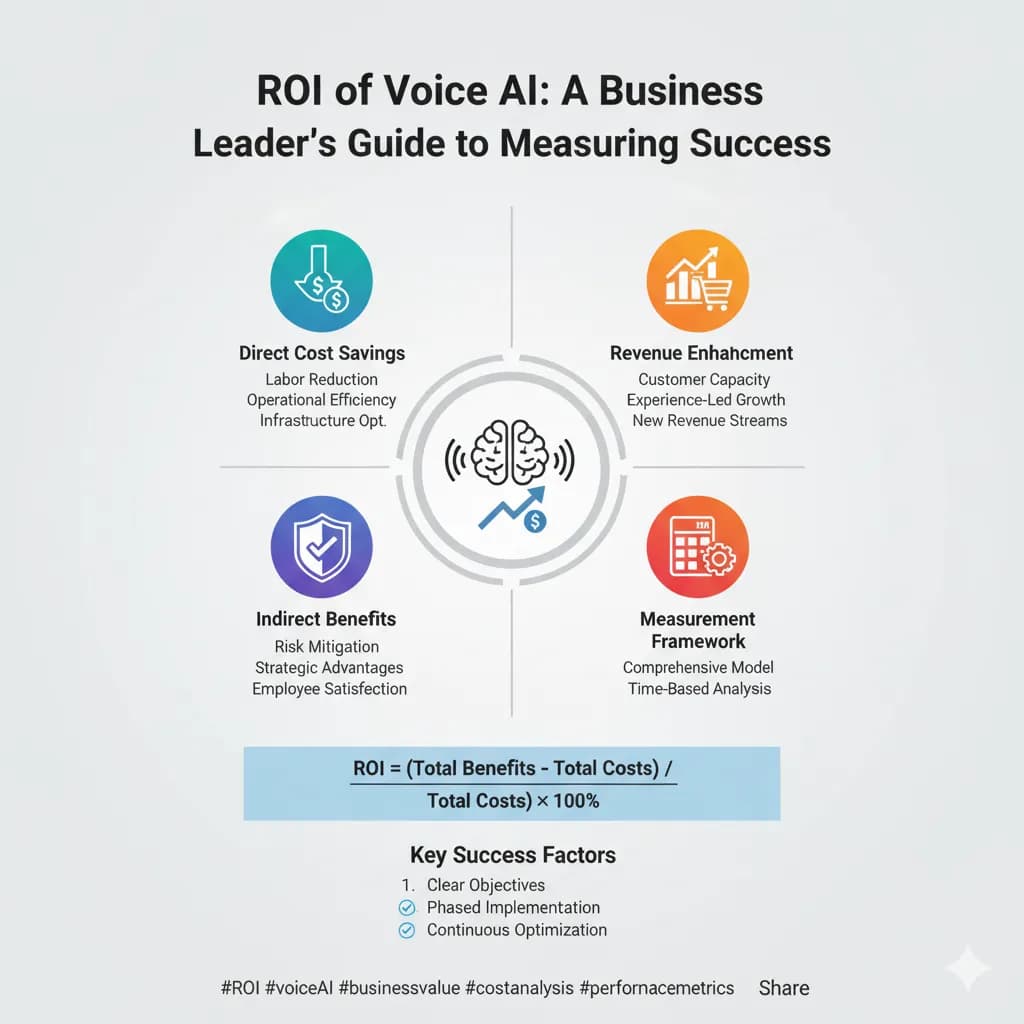
Direct Cost Savings
Labor Cost Reduction Voice AI can significantly reduce staffing requirements for routine tasks:
- Customer service inquiries handled without human intervention
- Appointment scheduling and management automation
- Information retrieval and basic support functions
- After-hours service coverage without additional staff
Operational Efficiency Gains
- Reduced call handling times through faster information access
- Elimination of repetitive manual processes
- Decreased error rates in data entry and processing
- Improved resource allocation and utilization
Infrastructure Cost Optimization
- Reduced need for physical call center space
- Lower telecommunications costs through intelligent routing
- Decreased software licensing for traditional phone systems
- Reduced training costs for routine procedures
Revenue Enhancement
Increased Customer Capacity
- Ability to handle more customer interactions simultaneously
- 24/7 service availability increasing sales opportunities
- Faster response times leading to higher conversion rates
- Reduced customer abandonment due to wait times
Improved Customer Experience Leading to Growth
- Higher customer satisfaction scores driving retention
- Positive word-of-mouth and referrals
- Increased customer lifetime value
- Premium pricing opportunities for superior service
New Revenue Streams
- Voice-enabled self-service options
- Proactive customer outreach capabilities
- Data insights enabling new product/service offerings
- Expansion into new markets or customer segments
Indirect Benefits
Risk Mitigation
- Reduced compliance violations through consistent processes
- Lower liability from human errors in critical interactions
- Improved security through standardized authentication
- Better audit trails and documentation
Strategic Advantages
- Competitive differentiation in the marketplace
- Faster adaptation to market changes
- Enhanced brand reputation for innovation
- Improved employee satisfaction and retention
ROI Calculation Framework
Basic ROI Formula
ROI = (Total Benefits - Total Costs) / Total Costs × 100%
Comprehensive ROI Model
Total Benefits = Direct Savings + Revenue Enhancement + Indirect Benefits
Total Costs = Initial Investment + Ongoing Costs + Opportunity Costs
Time-Based ROI Analysis
Year 1: Break-Even Analysis Focus on immediate cost savings and operational improvements
Years 2-3: Growth Phase Returns Include revenue enhancement and customer experience improvements
Years 3+: Strategic Value Realization Factor in competitive advantages and market positioning benefits
Industry-Specific ROI Models
Customer Service Operations
Typical Metrics:
- Cost per interaction reduction: 40-70%
- First-call resolution improvement: 15-25%
- Average handle time reduction: 20-40%
- Customer satisfaction increase: 10-30%
ROI Calculation Example:
Company Profile: Mid-size e-commerce company with 50,000 monthly customer service interactions
Current Costs:
- 15 full-time customer service agents × $40,000 annually = $600,000
- Benefits and overhead (30%) = $180,000
- Technology infrastructure = $50,000
- Total Annual Cost: $830,000
Voice AI Implementation:
- Initial setup and customization: $150,000
- Annual licensing and maintenance: $60,000
- Reduced staffing needs (8 agents instead of 15): $280,000 savings
- Improved efficiency gains: $100,000 additional value
Year 1 ROI:
- Total Benefits: $380,000
- Total Costs: $210,000
- ROI: 81%
Healthcare Organizations
Typical Metrics:
- Documentation time reduction: 50-70%
- Patient capacity increase: 20-35%
- Administrative cost reduction: 30-50%
- Patient satisfaction improvement: 15-25%
ROI Calculation Example:
Organization Profile: Multi-specialty clinic with 20 physicians
Current Challenges:
- Physicians spend 2 hours daily on documentation
- Administrative staff costs: $400,000 annually
- Lost revenue from scheduling inefficiencies: $200,000
Voice AI Solution:
- Initial investment: $200,000
- Annual operating costs: $80,000
- Documentation time savings: 1.5 hours per physician daily
- Value of physician time saved: $300,000 annually
- Administrative efficiency gains: $150,000
- Revenue recovery: $120,000
Year 1 ROI:
- Total Benefits: $570,000
- Total Costs: $280,000
- ROI: 104%
Financial Services
Typical Metrics:
- Call deflection rate: 60-80%
- Customer onboarding time reduction: 40-60%
- Compliance improvement: 95%+ accuracy
- Cross-selling opportunity increase: 25-40%
ROI Calculation Example:
Institution Profile: Regional bank with 100,000 customers
Current Operations:
- Call center costs: $1.2M annually
- Compliance and audit costs: $300,000
- Lost cross-selling opportunities: $500,000
Voice AI Implementation:
- Technology investment: $300,000
- Annual operations: $120,000
- Call center cost reduction: $600,000
- Compliance efficiency: $150,000
- Revenue enhancement: $250,000
Year 1 ROI:
- Total Benefits: $1,000,000
- Total Costs: $420,000
- ROI: 138%
Measuring and Tracking ROI
Key Performance Indicators (KPIs)
Operational Metrics:
- Call deflection rate
- Average handle time (AHT)
- First-call resolution (FCR)
- System uptime and reliability
- Error rates and accuracy
Financial Metrics:
- Cost per interaction
- Revenue per customer
- Customer acquisition cost (CAC)
- Customer lifetime value (CLV)
- Operating margin improvement
Customer Experience Metrics:
- Customer Satisfaction (CSAT) scores
- Net Promoter Score (NPS)
- Customer Effort Score (CES)
- Retention rates
- Complaint resolution times
Measurement Tools and Dashboards
Real-Time Monitoring:
- Live performance dashboards
- Alert systems for threshold breaches
- Capacity utilization tracking
- Quality assurance monitoring
Analytics and Reporting:
- Monthly ROI calculations
- Trend analysis and projections
- Comparative analysis against benchmarks
- Executive summary reports
Business Intelligence Integration:
- Integration with existing BI tools
- Custom report generation
- Predictive analytics for optimization
- Cross-functional performance correlation
Maximizing Voice AI ROI
Strategic Implementation Approaches
Phased Rollout Strategy
- Phase 1: High-impact, low-risk use cases (FAQ, basic inquiries)
- Phase 2: Medium complexity interactions (account management, scheduling)
- Phase 3: Advanced capabilities (complex problem solving, sales support)
Quick Win Identification
- Target repetitive, high-volume interactions
- Focus on clear pain points with measurable impact
- Choose use cases with strong business sponsorship
- Ensure adequate data availability for training
Optimization Techniques
Continuous Improvement Process
- Regular analysis of conversation data
- A/B testing of different approaches
- User feedback integration
- Model retraining and updates
Integration Enhancement
- Deeper CRM and business system integration
- Workflow automation expansion
- Cross-channel consistency improvement
- Data quality and accessibility enhancement
Scaling Strategies
- Geographic expansion of successful implementations
- Additional use case deployment
- Integration with emerging technologies
- Partnership and ecosystem development
Common ROI Pitfalls and How to Avoid Them
Pitfall 1: Underestimating Implementation Costs
Common Mistakes:
- Focusing only on software licensing costs
- Ignoring integration and customization requirements
- Underestimating training and change management needs
- Not planning for ongoing optimization and maintenance
Solutions:
- Conduct thorough cost analysis including all components
- Include 20-30% contingency for unexpected costs
- Plan for long-term operational expenses
- Factor in opportunity costs and resource allocation
Pitfall 2: Overestimating Short-Term Benefits
Common Mistakes:
- Expecting immediate full-scale benefits
- Not accounting for learning curves and adoption time
- Overestimating automation rates for complex interactions
- Ignoring customer and staff adjustment periods
Solutions:
- Use conservative estimates for initial projections
- Plan for gradual benefit realization over time
- Include realistic timelines for full implementation
- Monitor and adjust expectations based on actual performance
Pitfall 3: Focusing Only on Direct Cost Savings
Common Mistakes:
- Ignoring revenue enhancement opportunities
- Not measuring customer experience improvements
- Overlooking strategic and competitive advantages
- Missing indirect benefits like improved employee satisfaction
Solutions:
- Use comprehensive ROI models including all benefit categories
- Track both quantitative and qualitative improvements
- Consider long-term strategic value in calculations
- Include stakeholder feedback in benefit assessment
Pitfall 4: Inadequate Performance Tracking
Common Mistakes:
- Not establishing baseline measurements
- Using inappropriate or insufficient metrics
- Lacking real-time monitoring capabilities
- Not adjusting strategies based on performance data
Solutions:
- Establish clear baseline metrics before implementation
- Implement comprehensive monitoring and analytics
- Create regular review and optimization processes
- Use data-driven decision making for continuous improvement
Industry Benchmarks and Expectations
Typical ROI Timelines by Industry
Customer Service: 6-12 months to break-even, 80-150% ROI in Year 1 Healthcare: 8-15 months to break-even, 60-120% ROI in Year 1 Financial Services: 9-18 months to break-even, 70-140% ROI in Year 1 Retail/E-commerce: 4-8 months to break-even, 100-200% ROI in Year 1 Manufacturing: 12-20 months to break-even, 50-100% ROI in Year 1
Success Factors for High ROI
Top Performing Implementations Share:
- Clear business objectives and success criteria
- Strong executive sponsorship and support
- Comprehensive change management programs
- Robust data and integration strategies
- Continuous optimization and improvement processes
Building the Business Case
Executive Presentation Framework
Problem Statement
- Current pain points and inefficiencies
- Competitive pressures and market demands
- Cost and capacity constraints
- Customer experience challenges
Solution Overview
- Voice AI capabilities and features
- Implementation approach and timeline
- Resource requirements and responsibilities
- Risk mitigation strategies
Financial Analysis
- Detailed cost-benefit analysis
- ROI projections and sensitivity analysis
- Payback period and break-even timeline
- Comparison with alternative solutions
Success Metrics
- Key performance indicators
- Measurement and reporting approach
- Review and optimization processes
- Long-term strategic benefits
Risk Assessment and Mitigation
Technical Risks
- Integration challenges and solutions
- Performance and reliability concerns
- Security and compliance requirements
- Scalability and future-proofing considerations
Business Risks
- User adoption and change management
- Customer acceptance and satisfaction
- Competitive response and market changes
- Regulatory and legal considerations
Financial Risks
- Cost overruns and budget management
- Benefit realization delays
- Market and economic factors
- Technology obsolescence
Conclusion
Voice AI offers significant ROI potential across industries, but realizing these benefits requires careful planning, accurate measurement, and continuous optimization. The most successful implementations start with clear business objectives, use comprehensive ROI models, and maintain focus on both immediate cost savings and long-term strategic value.
Key takeaways for maximizing voice AI ROI:
- Start with realistic, comprehensive cost-benefit analysis
- Implement in phases to minimize risk and maximize learning
- Track both quantitative metrics and qualitative improvements
- Continuously optimize based on performance data and user feedback
- Consider both direct benefits and strategic competitive advantages
By following these principles and using the frameworks outlined in this guide, business leaders can confidently invest in voice AI technology and achieve substantial returns that justify the investment while positioning their organizations for future success.
The question isn't whether voice AI can deliver ROI—it's how quickly and effectively your organization can realize these benefits through strategic implementation and ongoing optimization.
Ready to build a compelling business case for voice AI in your organization? Our ROI specialists can help you develop detailed financial models and implementation strategies for a customized ROI assessment.